
Nissan Rogue Service Manual: Water hose
Exploded View
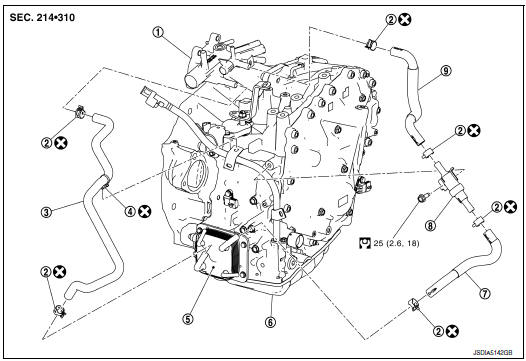
- Water outlet
- Hose clamp
- Water hose A
- Clip
- CVT oil warmer
- Transaxle assembly
- Water hose B
- Heater thermostat
- Water hose C
 : Always replace after every
disassembly.
: Always replace after every
disassembly.
 : N·m (kg-m, ft-lb)
Removal and Installation
REMOVAL
WARNING: Do not remove the radiator cap when the engine is hot. Serious burns could occur from high pressure engine coolant escaping from the radiator. Wrap a thick cloth around the cap. Slowly turn it a quarter turn to allow built-up pressure to escape. Carefully remove the cap by turning it all the way.
CAUTION: Perform when the engine is cold.
NOTE: When removing components such as hoses, tubes/lines, etc., cap or plug openings to prevent fluid from spilling.
- Remove battery tray. Refer to PG-76, "Removal and Installation (Battery Tray)".
- Remove engine under cover. Refer to EXT-16, "Exploded View".
- Remove CVT fluid charging pipe. Refer to TM-220, "Exploded View".
- Remove fender protector side cover. Refer to EXT-28, "FENDER PROTECTOR : Exploded View".
- Remove water hose A, B, C, and heater thermostat.
INSTALLATION
Installation is in the reverse order of removal.
CAUTION:
- Do not reuse hose clamps.
- Do not reuse hose clip
- Securely install the water hose clip to the bracket hole of charging pipe.
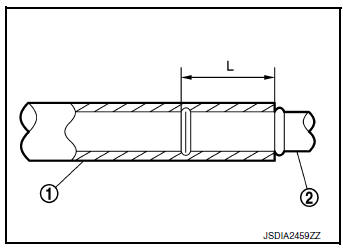
- Refer to the following when installing water hoses.

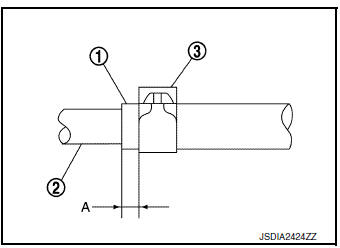
- Refer to the followings when installing hose clamp.
CAUTION: Hose clamp should not interfere with the bulge of tube.

Inspection
INSPECTION AFTER REMOVAL
Heater Thermostat
- Fully immerse the heater thermostat 1 in a container (A) filled with water. Continue heating the water while stirring.
- Continue heating the heater thermostat for 5 minutes or more after bringing the water to a boil.

- Quickly take the heater thermostat out of the hot water, measure the heater thermostat within 10 seconds.
- Place dial indicator (A) on the pellet B and measure the elongation from the initial state.

Standard : Refer to TM-226, "Heater Thermostat".
- If out of standard, replace heater thermostat.
INSPECTION AFTER INSTALLATION
Start the engine, and check the joints for coolant leakage.
 Differential side oil seal
Exploded View
Transaxle assembly
Differential side oil seal (left side)
Differential side oil seal (right side)
(FWD models only)
: Always replace after every
disassembly.
: Appl ...
 Fluid cooler hose
Exploded View
COMPONENT PARTS LOCATION
Transaxle assembly
Fluid cooler hose A
Hose clamp
Fluid cooler hose B
CVT oil warmer
To radiator
: Always replace after every
disassem ...
Other materials:
ID registration procedure
Description
This procedure must be performed after replacement of a tire pressure sensor
or BCM.
Work Procedure
TPMS ID registration can be performed using one of the following procedures:
Transmitter Activation tool [KV48105501 (J-45295-A)] with CONSULT
(preferred method)
...
Steering column covers
Removal and Installation
REMOVAL
Release gap hider (1) pawls from the steering column upper
cover (2).
: Pawl
Remove steering column cover screws (A)
NOTE:
Rotate steering wheel to access steering column cover screws.
Release steering column upper cover (1) pawls u ...
Periodic maintenance
REAR DIFFERENTIAL GEAR OIL
Inspection
OIL LEAKS
Make sure that oil is not leaking from final drive assembly or around it.
OIL LEVEL
Remove filler plug (1) and check oil level from filler plug
mounting
hole as shown.
CAUTION:
Do not start engine while checking oil level.
&nbs ...
