
Nissan Rogue Service Manual: Symptom diagnosis
CHASSIS CONTROL
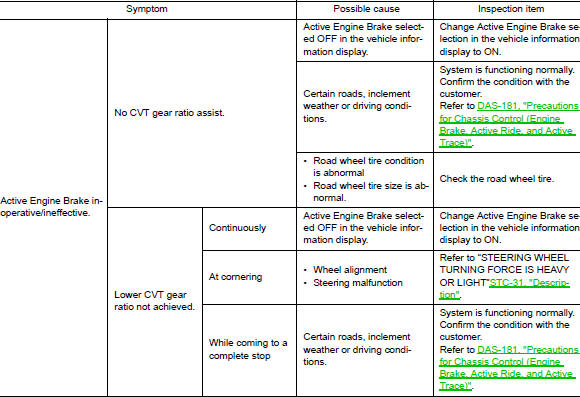
Active Engine Brake
NOTE:
- For the operational conditions of Active Engine Brake, refer to DAS-175, "System Description - Active Engine Brake".
- Perform the self-diagnosis with CONSULT before the symptom diagnosis. Perform the trouble diagnosis if any DTC is detected.
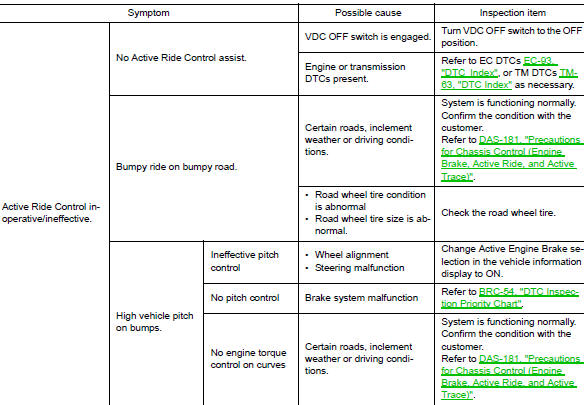
Active Ride Control
NOTE:
- For the operational conditions of Active Ride Control, refer to DAS-176, "System Description - Active Ride Control".
- Perform the self-diagnosis with CONSULT before the symptom diagnosis. Perform the trouble diagnosis if any DTC is detected.
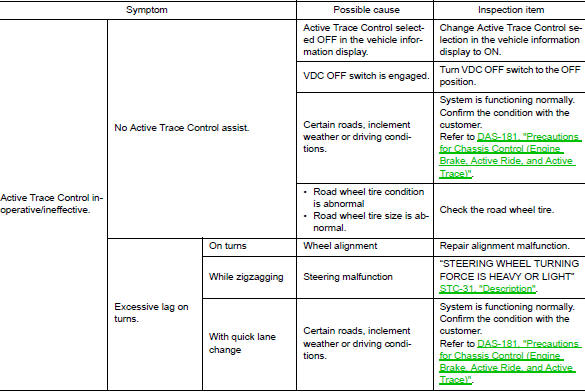
Active Trace Control
NOTE:
- For the operational conditions of Active Trace Control, refer to DAS-176, "System Description - Active Trace Control".
- Perform the self-diagnosis with CONSULT before the symptom diagnosis. Perform the trouble diagnosis if any DTC is detected.
NORMAL OPERATING CONDITION
Description
CHASSIS CONTROL
- Chassis Control will not provide all the necessary controls to replace driver intervention. It is not designed to prevent loss of control. It is the driver’s responsibility to stay alert, drive safely, keep the vehicle in the traveling lane, and be in control of vehicle at all times.
- Chassis Control is primarily intended for use on well-developed freeways or highways. It may not perform satisfactorily in certain roads, weather or driving conditions.
- Using Chassis Control under some conditions of road, corner or severe weather could lead to an unexpected system operation. In such conditions, driver needs to correct the vehicle's direction with driver's steering operation to avoid accidents.
- When Chassis Control is operating, avoid excessive or sudden steering maneuvers. Otherwise, you could lose control of the vehicle.
- Engine Brake Control is designed to enhance braking feel and traceability at corners.
- Active Ride Control is designed to enhance handling and drive comfort.
- Active Trace Control is designed to enhance traceability at corners and smooth vehicle movement for more confident driving.
- Chassis Control may not function properly under the following conditions:
- During bad weather (rain, fog, snow, wind, etc.).
- When driving on slippery roads, such as on ice or snow, etc.
- When driving on winding or uneven roads.
- When driving with a tire that is not within normal tire conditions (for example, tire wear, low tire pressure, installation of spare tire, tire chains, non-standard wheels)
- When the vehicle is equipped with non-original steering parts or suspension parts.
- The functions of Chassis Control may or may not operate properly under the following conditions:
- On roads covered with water, dirt or snow, etc.
- On roads where there are sharp curves.
 DTC/circuit diagnosis
C1B92-00 BRAKE CONTROL SYSTEM
DTC Description
DTC DETECTION LOGIC
DTC
Display Item
(Trouble diagnosis content)
Malfunction detected condition
C1B92-00
BRAKE ...
 Removal and installation
CHASSIS CONTROL MODULE
Exploded View
Steering member
Chassis control module
Front
Removal and Installation
CAUTION:
When replacing chassis control module, configuration of ch ...
Other materials:
Main power window and door lock/unlock switch
Removal and Installation
REMOVAL
Remove the front door pull handle bracket (LH). Refer to INT-15,
"Removal and Installation".
Release pawls using a suitable tool (A) and remove main power
window and door lock/unlock switch finisher (1).
: Pawl
Disconnect t ...
Unit disassembly and assembly
FRONT DRIVE SHAFT
Exploded View (LH)
Shaft
Circular clip
Dust shield
Housing
Snap ring
Spider assembly
Stopper ring
Boot
Boot band
Joint sub-assembly
Wheel side
Disassembly and Assembly (LH)
DISASSEMBLY
Transaxle Assembly Side
Fix shaft with a v ...
Drinking alcohol/drugs and driving
WARNINGNever drive under the influence of alcohol
or drugs. Alcohol in the bloodstream reduces
coordination, delays reaction time
and impairs judgement. Driving after
drinking alcohol increases the likelihood
of being involved in an accident injuring
yourself and others. Add ...
