
Nissan Rogue Service Manual: Refrigeration system symptoms
Trouble Diagnosis For Unusual Pressure
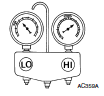
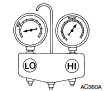
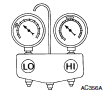
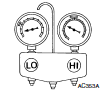
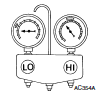
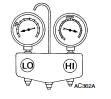
Diagnose using a manifold gauge whenever system’s high and/or low side pressure(s) is/are unusual. The marker above the gauge scale in the following tables indicates the standard (usual) pressure range. Refer to above table (Ambient air temperature-to-operating pressure table) since the standard (usual) pressure, however, differs from vehicle to vehicle.
Symptom Table
|
Gauge indication |
Refrigerant cycle |
Probable cause |
Corrective action |
| Both high- and low-pressure sides
are too high.
|
The pressure returns to normal is reduced soon after water is splashed on condenser. | Excessive refrigerant charge in refrigeration cycle. | Reduce refrigerant until specified pressure is obtained. |
| Air suction by cooling fan is insufficient. | Insufficient condenser cooling
performance.
↓
|
|
|
|
Poor heat exchange in condenser
(After compressor operation
stops, high-pressure decreases
too slowly). ↓ Air in refrigeration cycle. |
Evacuate repeatedly and recharge system. | |
| Engine tends to overheat. | Engine cooling systems malfunction | Check and repair each engine cooling system. | |
|
↓ Improper expansion valve adjustment. |
Replace expansion valve. | |
| High-pressure side is too high and
low-pressure side is too low.
|
Upper side of condenser and high-pressure side are hot, however, liquid tank is not so hot. | High-pressure tube or parts located between compressor and condenser are clogged or crushed |
|
| High-pressure side is too low and
low-pressure side is too high.
|
High- and low-pressure sides become equal soon after compressor operation stops. | Compressor pressure operation
is improper. ↓ Damaged inside compressor packings. |
Replace compressor |
| No temperature difference between high- and low-pressure sides. | Compressor pressure operation
is improper. ↓ Damaged inside compressor packings. |
Replace compressor. | |
| Both high- and low-pressure sides
are too low.
|
|
Liquid tank inside is slightly clogged. |
|
|
High-pressure pipe located between liquid tank and expansion valve is clogged. |
|
|
| Expansion valve and liquid tank are warm or slightly cool when touched. | Low refrigerant charge. ↓ Leaking fittings or components. |
Check refrigerant for leaks. Refer to HA-21, "Leak Test". | |
| There is a big temperature difference between expansion valve inlet and outlet while the valve itself is frosted. | compared with the specification. ↓
|
|
|
| An area of the low-pressure pipe is colder than areas near the evaporator outlet. | Low-pressure pipe is clogged or crushed. |
|
|
| Air flow volume is not enough or is too low. | Evaporator is frozen. |
|
|
| Low-pressure side sometimes becomes
negative.
|
|
Refrigerant does not discharge
cyclically. ↓ Moisture is frozen at expansion valve outlet and inlet. ↓ Water is mixed with refrigerant. |
|
| Low-pressure side becomes negative.
|
Liquid tank or front/rear side of expansion valve’s pipe is frosted or wet with dew. | High-pressure side is closed
and refrigerant does not flow. ↓ Expansion valve or liquid tank is frosted. |
Leave the system at rest until
no frost is present. Start it again
to check whether or not the malfunction
is caused by water or
foreign particles.
|

 Compressor system symptoms
Symptom Table
Follow the next table and perform trouble diagnosis if there is a compressor
unit malfunction (internal noise,
insufficient cooling).
Symptom
Inspection method
...
Other materials:
Fuel efficient driving tips
Follow these easy-to-use Fuel Efficient Driving
Tips to help you achieve the most fuel economy
from your vehicle.
Use Smooth Accelerator and Brake
Pedal Application
Avoid rapid starts and stops.
Use smooth, gentle accelerator and
brake application whenever possibl ...
System description
COMPONENT PARTS
Component Part Location
RH side of engine compartment
RH front of vehicle (view with front
bumper fascia removed)
No.
Component
Description
1
IPDM E/R
Refer to PCS-5, "RELAY CONTROL SYSTEM : System Description".
...
P117A air fuel ratio
DTC Description
DTC DETECTION LOGIC
DTC No.
CONSULT screen terms
(Trouble diagnosis content)
DTC detecting condition
P117A
AIR FUEL RATIO B1
(AIR FUEL RATIO B1)
ECM detects a lean/rich air fuel ratio state in any cylinder for a
specified
length of time.
...
