
Nissan Rogue Service Manual: Radiator
RADIATOR CAP
RADIATOR CAP : Inspection
CHECKING RADIATOR CAP
- Inspect the radiator cap.
- Replace the cap if the metal plunger cannot be seen around the edge of the black rubber gasket.
- Replace the cap if deposits of waxy residue or other foreign material are on the black rubber gasket or the metal retainer.
NOTE: Thoroughly wipe out the radiator filler neck to remove any waxy residue or foreign material.
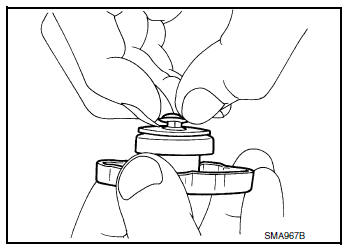
- Pull the negative-pressure valve to open it and check that it closes completely when released.
- Check that there is no dirt or damage on the valve seat of the radiator cap negative-pressure valve.
- Check that there are no abnormalities in the opening and closing conditions of the negative-pressure valve.
- Check radiator cap relief pressure using suitable tool (A/B).
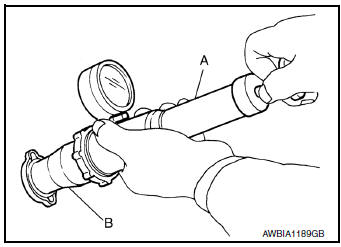
Standard : Refer to CO-25, "Radiator"
- Apply water or engine coolant to the cap seal surface before connecting the radiator cap to the tester.
- Replace the radiator cap if there is an abnormality in the negative- pressure valve, or if the open-valve pressure is outside of the standard values.
RADIATOR
RADIATOR : Inspection
Check radiator for mud or clogging. If necessary, clean radiator as follows.
CAUTION:
- Be careful not to bend or damage radiator fins.
- When radiator is cleaned without removal, remove all surrounding parts such as radiator cooling fan assembly and horns. Then tape harness and harness connectors to prevent water from entering.
- Spray water to the back side of the radiator core using a side to side motion from the top down.
- Stop spraying when debris no longer flows from radiator core.
- Blow air into the back side of radiator core using a side to side motion from the top down.
- Use compressed air lower than 490 kPa (5 kg/cm2, 71 psi) and keep distance more than 30 cm (11.8 in).
- Continue to blow air until no water sprays out.
- Check for engine coolant leaks. Repair as necessary.
 Engine coolant
Inspection
LEVEL
Check that the reservoir tank engine coolant level is within the
“MIN� to “MAX� when the engine is cool.
(A) : MAX
(B) : MIN
Adjust the engine coolant l ...

Other materials:
Active trace control
This system senses driving based on the driver’s
steering and acceleration/braking patterns, and
controls brake pressure at individual wheels to
aid tracing at corners and help smooth vehicle
response.
The Active Trace Control can be set to ON (enabled)
or OFF (disabled) through the Vehicl ...
Precaution
Precaution for Supplemental Restraint System (SRS) "AIR BAG" and "SEAT
BELT
PRE-TENSIONER"
The Supplemental Restraint System such as “AIR BAG� and “SEAT BELT PRE-TENSIONER�,
used along
with a front seat belt, helps to reduce the risk or severity of injury to the
...
System description
CAN COMMUNICATION SYSTEM
System Description
CAN communication is a multiplex communication system. This enables the
system to transmit and receive
large quantities of data at high speed by connecting control units with two
communication lines (CAN-H and
CAN-L).
Control units o ...
