
Nissan Rogue Service Manual: Special Cautions to Ensure the Safe Disposal of Sodium-filled Exhaust Valves
Handling and disposal of sodium-filled exhaust valves requires special care and consideration. Under conditions such as breakage with subsequent contact with water, metal sodium which lines the inner portion of exhaust valve will react violently, forming sodium hydroxide and hydrogen which may result in an explosion. Sodium-filled exhaust valve is identified on the top of its stem as shown in illustration.
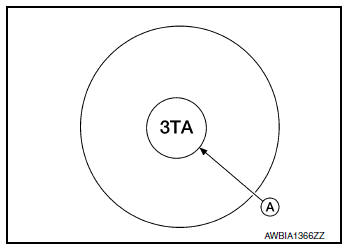
(A) : Identification mark of sodium-filled exhaust valve
DEALER DISPOSAL INSTRUCTIONS
CAUTION:
- Use approved shatter-resistant eye protection when performing this procedure.
- Perform this and all subsequent disposal work procedures in an open room, away from flammable liquids. Keep a fire extinguisher, rated at least 10 ABC, in close proximity to the work area.
- Be sure to wear rubber gloves when performing the following operations.
- Make sure the resultant (high alkalinity) waste water does not contact your skin. If the waste water does contact you, wash the contacted area immediately with large quantities of water.
- Dealers should check their respective state and local regulations concerning any chemical treatment or waste water discharge permits which may be required to dispose of the resultant (high alkalinity) waste water.
- Clamp valve stem in a vice.
- The valve has a specially-hardened surface. To cut through it, first remove a half-round section, approximately 30 mm (1.18 in) long using air-powered grinder until black color is removed and silver color appears.

(A) : Black color
(B) : Silver color
(c) : 47 mm (1.85 in)
(d) : 17 mm (0.67 in)
- Use hacksaw to cut through approximately half the diameter of valve stem. Make the serration at a point 40 mm (1.57 in) from the end of valve stem.
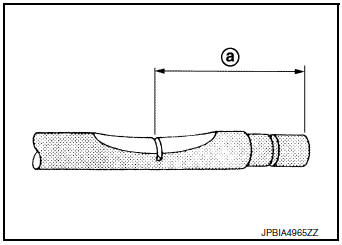
(a) : 40 mm (1.57 in)

- Cover the serrated end of the valve with a large shop towel (A).
Strike the valve face end with a hammer, separating it into two pieces.
- Fill a bucket, such as a 20
 (5-1/4 US gal, 4-3/8 Imp gal)
oil
can, with at least 10
(5-1/4 US gal, 4-3/8 Imp gal)
oil
can, with at least 10  (2-5/8 US
gal, 2-1/4 lmp gal) of water.
(2-5/8 US
gal, 2-1/4 lmp gal) of water.Carefully place the already cut (serrated) valves into the water one-at-a-time using a set of large tweezers and quickly move away at least 2.7 m (9 ft).
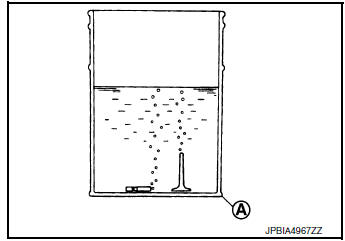
- The valves should be placed in a standing position as shown in
the illustration to allow complete reaction. After the bubbling
action has subsided, additional valves can be placed into the
bucket allowing each subsequent chemical reaction to subside.
However, no more than 8 valves should be placed in the same 10
(2-5/8 US gal, 2-1/4 lmp
gal) amount of water. The complete
chemical reaction may take as long as 4 to 5 hours.Remove the valves using a set of large tweezers after the chemical reaction has stopped. Afterwards, valves can be disposed as ordinary scrap.
A : Bucket [Such as 20 (5-1/4 US gal, 4-3/8 Imp gal) oil can]
 Precaution
Precaution for Supplemental Restraint System
(SRS) "AIR BAG" and "SEAT BELT PRE-TENSIONER"
The Supplemental Restraint System such as “AIR BAGâ€� and “SEAT BELT PRE-TENSIONERâ ...
 Liquid Gasket
REMOVAL OF LIQUID GASKET SEALING
After removing the bolts and nuts, separate the mating surface and
remove the liquid gasket using Tool (A).
Tool Number : KV10111100 (J-37228)
CAUTION:
Be c ...
Other materials:
Basic inspection
DIAGNOSIS AND REPAIR WORK FLOW
Work Flow
DETAILED FLOW
1.INTERVIEW FROM THE CUSTOMER
Clarify customer complaints before inspection. First of all, perform an
interview utilizing DAS-202, "Diagnostic
Work Sheet" and reproduce the symptom as well as fully understand it. Ask
customer ...
C1199 brake booster
DTC Logic
DTC DETECTION LOGIC
DTC
Display Item
Malfunction detected condition
Possible causes
C1199
BRAKE BOOSTER
When brake booster vacuum is approx. 0 kPa (0 mm-
Hg) during engine running.
Harness or connector
Vacuum sensor (brake booster)
...
Service data and specifications (SDS)
Wheel Alignment (Unladen*1)
*1: Fuel, engine coolant, and lubricants are full. Spare tire, jack, hand
tools, and mats are in designated positions.
*2: Since an adjustment mechanism is not included, the value of the left and
right wheels must be used as the standard value.
Wheelarch Height ...
