
Nissan Rogue Service Manual: CVT fluid cooler system
Cleaning
Whenever an automatic transaxle is repaired, overhauled, or replaced, the CVT fluid cooler mounted in the radiator must be inspected and cleaned.
Metal debris and friction material, if present, can be trapped or be deposited in the CVT fluid cooler. This debris can contaminate the newly serviced CVT or, in severe cases, can block or restrict the flow of CVT fluid.
In either case, malfunction of the newly serviced CVT may occur.
Debris, if present, may deposit as CVT fluid enters the cooler inlet. It will be necessary to back flush the cooler through the cooler outlet in order to flush out any built up debris.
CVT FLUID COOLER CLEANING PROCEDURE
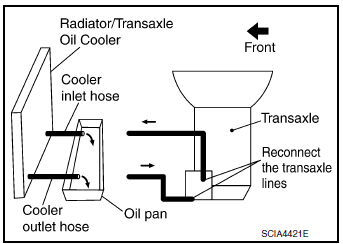
- Position an oil pan under the transaxle's inlet and outlet cooler hoses.
- Identify the inlet and outlet fluid cooler hoses.
- Disconnect the fluid cooler inlet and outlet rubber hoses from the
steel cooler tubes or bypass valve.
NOTE: Replace the cooler hoses if rubber material from the hose remains on the tube fitting.
- Allow any CVT fluid that remains in the cooler hoses to drain into the oil pan.
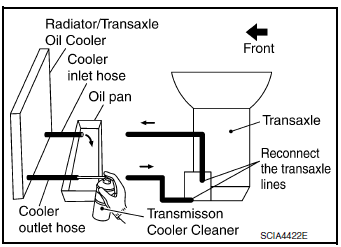
- Insert the extension adapter hose of a can of Transmission Cooler Cleaner (Nissan P/N 999MP-AM006) into the cooler outlet hose.
CAUTION:
- Wear safety glasses and rubber gloves when spraying the Transmission Cooler Cleaner.
- Spray Transmission Cooler Cleaner only with adequate ventilation.
- Avoid contact with eyes and skin.
- Never breath vapors or spray mist.
- Hold the hose and can as high as possible and spray Transmission Cooler Cleaner in a continuous stream into the cooler outlet hose until CVT fluid flows out of the cooler inlet hose for 5 seconds.
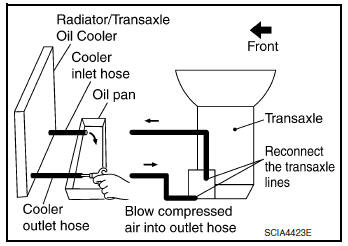
- Insert the tip of an air gun into the end of the cooler outlet hose.
- Wrap a shop rag around the air gun tip and end of the cooler outlet hose.
- Blow compressed air regulated to 5 to 9 kg/cm2 (70 to 130 psi) through the cooler outlet hose for 10 seconds to force out any remaining CVT fluid.
- Repeat steps 5 through 9 three additional times.
- Position an oil pan under the banjo bolts that connect the CVT fluid cooler steel lines to the transaxle.
- Remove the banjo bolts.
- Flush each steel line from the cooler side back toward the transaxle by spraying Transmission Cooler Cleaner in a continuous stream for 5 seconds.
- Blow compressed air regulated to 5 to 9 kg/cm2 (70 to 130 psi) through each steel line from the cooler side back toward the transaxle for 10 seconds to force out any remaining CVT fluid.
- Ensure all debris is removed from the steel cooler lines.
- Ensure all debris is removed from the banjo bolts and fittings.
- Perform “CVT FLUID COOLER DIAGNOSIS PROCEDURE�.
CVT FLUID COOLER DIAGNOSIS PROCEDURE
NOTE: Insufficient cleaning of the cooler inlet hose exterior may lead to inaccurate debris identification.
- Position an oil pan under the transaxle's inlet and outlet cooler hoses.
- Clean the exterior and tip of the cooler inlet hose.
- Insert the extension adapter hose of a can of Transmission Cooler Cleaner (Nissan P/N 999MP-AM006) into the cooler outlet hose.
CAUTION:
- Wear safety glasses and rubber gloves when spraying the Transmission Cooler Cleaner.
- Spray Transmission Cooler Cleaner only with adequate ventilation.
- Avoid contact with eyes and skin.
- Never breath vapors or spray mist.
- Hold the hose and can as high as possible and spray Transmission Cooler Cleaner in a continuous stream into the cooler outlet hose until CVT fluid flows out of the cooler inlet hose for 5 seconds.
- Tie a common white, basket-type coffee filter to the end of the cooler inlet hose.
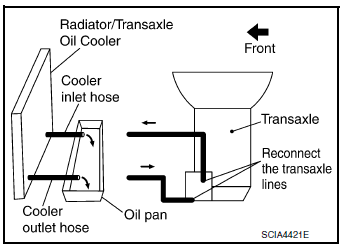
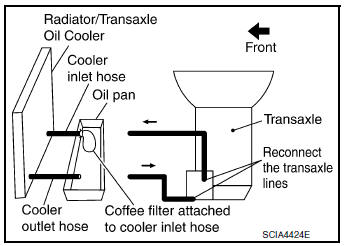
- Insert the tip of an air gun into the end of the cooler outlet hose.
- Wrap a shop rag around the air gun tip and end of cooler outlet hose.
- Blow compressed air regulated to 5 to 9 kg/cm2 (70 to 130 psi) through the cooler outlet hose to force any remaining CVT fluid into the coffee filter.
- Remove the coffee filter from the end of the cooler inlet hose.
- Perform “CVT FLUID COOLER INSPECTION PROCEDURE�.

CVT FLUID COOLER INSPECTION PROCEDURE
- Inspect the coffee filter for debris.
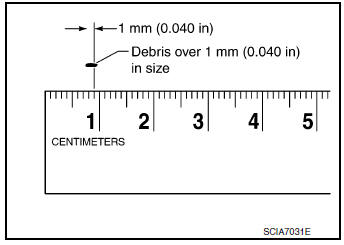
- If small metal debris less than 1 mm (0.040 in) in size or metal powder is found in the coffee filter, this is normal. If normal debris is found, the CVT fluid cooler/radiator can be reused and the procedure is ended.
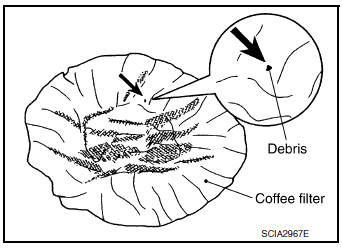
- If one or more pieces of debris are found that are over 1 mm (0.040 in) in size and/or peeled clutch facing material is found in the coffee filter, the fluid cooler is not serviceable. The radiator/ fluid cooler must be replaced and the inspection procedure is ended.
CVT FLUID COOLER FINAL INSPECTION
After performing all procedures, ensure that all remaining oil is cleaned from all components.
 Additional service when replacing TCM and transaxle assembly
Description
When replacing TCM and transaxle assembly simultaneously, perform the
following work.
TCM PROGRAMMING
Since vehicle specifications are not yet written in a new TCM, it
i ...
 Stall test
Work Procedure
INSPECTION
Check the engine oil level. Replenish if necessary. Refer to LU-7,
"Inspection".
Check for leak of the CVT fluid. Refer to TM-190, "Inspe ...
Other materials:
NISSAN Voice Recognition System
(if so equipped)
The NISSAN Voice Recognition system allows
hands-free operation of the systems equipped on
this vehicle, such as the phone and navigation
systems.
To operate NISSAN Voice Recognition, press
the button located on the steering
wheel.
When prompted, speak the command for the
system you wi ...
Removal and installation
ACCELERATOR PEDAL ASSEMBLY
Exploded View
Brake pedal
Accelerator pedal assembly
Locator hook
Locator pin
Bolt
Removal and Installation
REMOVAL
Disconnect the harness connector from the accelerator pedal
assembly.
Remove the bolts, then rem ...
Changing a flat tire
If you have a flat tire, follow the instructions below:
Stopping the vehicle
Safely move the vehicle off the road and
away from traffic.
Turn on the hazard warning flashers.
Park on a level surface and apply the parking
brake. Move the shift lever to P (Park).
...
